
Last Updated: November 8, 2026
Quick Summary
Water ingress and failed waterproofing are the most common and most damaging exterior building defects in Sydney commercial properties, followed by cracking, roof and flashing faults, concrete spalling, façade deterioration and balcony or fire safety defects. Inspect walls, roofs, gutters, concrete, balconies and wet areas on a set schedule, document everything with dated photos, and fix water-related defects first because they cause the most downstream damage.
- Water penetration through failed membranes, cracked sealant or poor drainage causes more damage than any other single defect.
- Parts of the Sydney basin contain reactive clay soils that shrink and swell, stressing footings and walls above.
- Wide or actively widening cracks and diagonal cracks from opening corners warrant a structural assessment.
- Concrete spalling accelerates once started and creates falling-hazard risk, especially on balconies and car park edges.
- Check walls and gutters quarterly, and roofs, concrete, balconies and wet areas twice yearly.
Table of Contents
- Why Exterior Building Defects Hit Commercial Properties Harder
- Water Ingress and Failed Waterproofing: The Most Common Defect
- Cracking: Structural, Non-Structural and Hairline Cracks
- Roof, Gutter and Flashing Defects
- Commercial Concrete Spalling and Reinforcement Corrosion
- Façade Deterioration and Combustible Cladding Compliance
- Balcony, Wet Area and Fire Safety Defects
- Your Commercial Building Exterior Maintenance Checklist
- Frequently Asked Questions
Why Exterior Building Defects Hit Commercial Properties Harder
Water pooling behind a failed seal. A hairline crack spreading across a concrete slab. A stain on a ceiling tile that keeps coming back after every heavy rain. These are the small warning signs of common exterior building defects in Sydney commercial properties, and they rarely stay small for long.
The pattern is common on commercial buildings: defects a homeowner could ignore for a year can become business problems within weeks. A leaking façade damages more than render, it gets into tenancy spaces, disrupts tenants, triggers insurance questions, and adds an unplanned maintenance line item.
The core tension: exterior building defects are cheap to catch early and expensive to catch late. Commercial properties have more surface area, occupants, and compliance obligations than a house, so the cost of delay multiplies.
Below, we cover what to inspect, which defects matter most, and how to prioritise repairs by safety risk and urgency, plus how regular exterior maintenance, including professional cleaning, prevents many of these problems.
Water Ingress and Failed Waterproofing: The Most Common Defect
Water ingress is the most common and most damaging exterior defect in commercial buildings. Water penetration through failed membranes, cracked sealant, or poor drainage is behind more interior damage, tenant complaints, and repair bills than any other single cause.
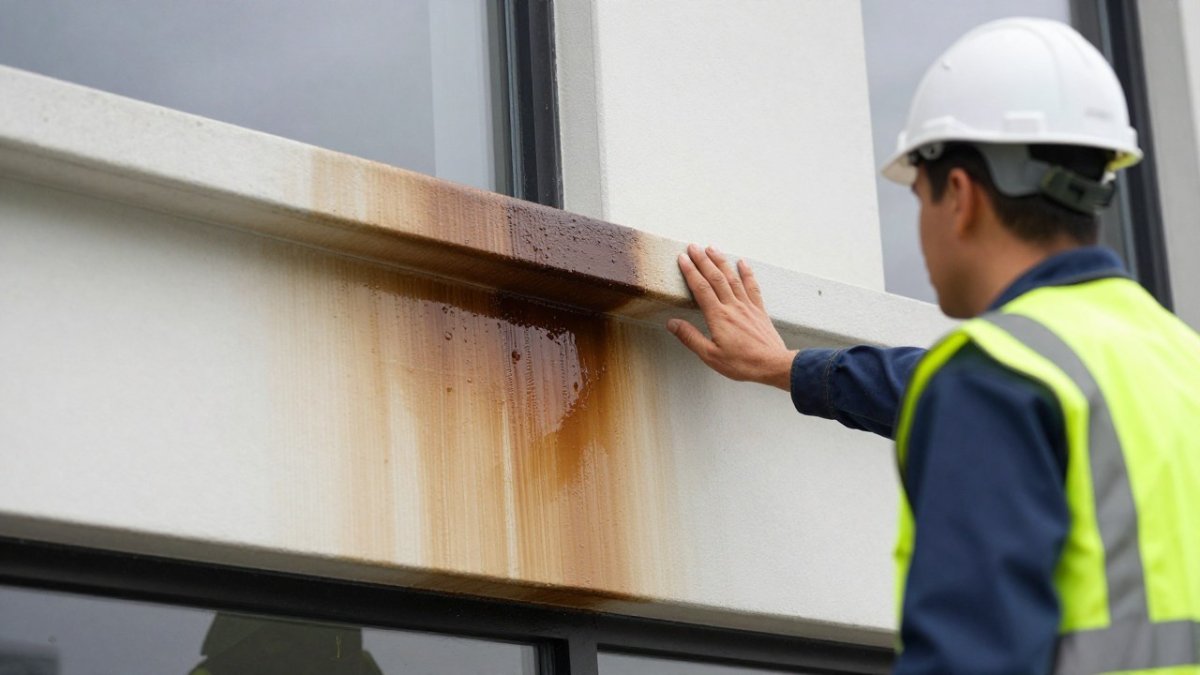
The warning signs are usually visible from ground level. Look for dark staining on external walls, bubbling or flaking paint, efflorescence (the white salt deposits left as moisture dries), and rust marks around fixings.
Waterproofing fails predictably. Membranes crack with age, improper sealing around penetrations lets water track behind cladding, and blocked or undersized drainage holds water against surfaces.
Regular exterior cleaning plays a bigger role here than most owners realise. Why regular building exterior cleaning prevents damage covers how removing built-up grime, mould, and organic growth lets you spot early staining and keeps drainage paths clear before water finds a way in.
Watch out: sealing over a damp patch without finding the water source traps moisture and accelerates the damage underneath.
Cracking: Structural, Non-Structural and Hairline Cracks
Cracking is the most often misread defect on commercial properties.
Hairline cracks are fine, surface-level lines, typically in render, paint, or thin applied finishes.
Non-structural cracks appear in masonry, cladding, and panel joints, commonly following building movement, thermal expansion and contraction, or minor settlement.
Structural cracking is the category that requires immediate action.
Local ground conditions matter. Parts of the Sydney basin contain reactive clay soils that shrink and swell with moisture, stressing footings and the walls above.
For commercial owners and facility managers, the practical response is a severity framework rather than a single ‘fix it’ decision:
- Immediate action: wide or actively widening cracks, diagonal cracks from opening corners, cracks with visible displacement, or any crack paired with falling material risk. These warrant a structural assessment before the next tenant cycle or weather event.
- Programmed repair: stable non-structural cracks that are letting water in. Seal and monitor, and fold them into the next façade maintenance window.
- Monitor: hairline and cosmetic cracks with no water staining. Photograph with a date reference and re-check at each inspection.
Documentation helps separate a managed defect from an argument.
Watch out: sealing a crack without identifying whether it is active traps moisture and hides the evidence you need to judge whether the building is still moving.
Cracking rarely exists in isolation. Tracing each crack to its moisture, movement, or corrosion source helps prioritise repairs and ongoing checks, with Task Genie supporting a consistent approach to exterior maintenance.
Roof, Gutter and Flashing Defects
Roof defects start small and show up far from the roof. A failed flashing, a blocked gutter, or a cracked roof sheet lets water into the building envelope, and the first sign is often a ceiling stain two floors down.
The usual suspects:
- Roof flashing that has lifted, corroded, or been poorly sealed at junctions and penetrations
- Gutters blocked with leaves and debris, causing water to back up and overflow against the façade
- Downpipes disconnected or undersized, dumping water at the base of walls
- Roof sheets and membranes that have cracked, blistered, or passed their service life
Gutter and drainage problems are the easiest to prevent and most commonly neglected. A blocked gutter in a storm doesn’t just overflow, it sends water down external walls and into the building. Clear gutters before storm season and check flashings after severe weather.
Commercial Concrete Spalling and Reinforcement Corrosion
Concrete spalling, often called concrete cancer, is the breakdown of concrete caused by reinforcement corrosion. It’s one of the most serious exterior defects on commercial properties because it affects structural elements, not just appearance.
The process is straightforward. Water and salts penetrate the concrete, reach the steel reinforcement, and start it rusting. Rusting steel expands, and that expansion cracks and blows off the surrounding concrete. Once spalling starts, it accelerates.
Look for rust staining on concrete, cracking along the line of reinforcement, and chunks breaking away, especially on balconies, car park edges, columns, and exposed slabs. Coastal exposure speeds this up, making spalling a particular concern near the water.
Spalling is not a cosmetic fix. Left alone, it reduces structural capacity and creates falling-hazard risk. How to maintain commercial concrete surfaces in Sydney covers the practical steps for protecting concrete and catching deterioration early.
Façade Deterioration and Combustible Cladding Compliance
A building façade takes everything the weather throws at it, and deterioration is inevitable without maintenance. A commercial building facade inspection checks the external wall system for cracking, delamination, failed sealant, corrosion of fixings, and loose or drummy panels.
Façade deterioration matters for two reasons: it’s the front line against water ingress, and loose elements are a public safety risk, particularly above walkways and entries.
Combustible cladding sits in a separate compliance category. Combustible cladding is a compliance matter that owners need to identify and manage. If you’re unsure what’s on your building, get it assessed by a qualified professional. This is a compliance matter, not a cosmetic one, and it should be prioritised alongside structural defects.
Balcony, Wet Area and Fire Safety Defects
Balconies, external wet areas, and fire safety systems are where exterior defects carry the highest consequence on a commercial property. They combine constant moisture exposure, occupant safety, and compliance obligations, and they are the areas where a small defect most often becomes a business interruption or a liability question.
Balconies and external wet areas
Balconies and external wet areas rely on a waterproofing membrane beneath the surface. When it fails, water gets into the structure and the tenancy or car park below, showing up as ceiling stains, damaged finishes, and tenant complaints several metres away.
Check balconies and wet areas for:
- Ponding water that does not drain after rain, which points to falls or blocked outlets
- Lifting, drummy, or cracked tiles
- Failed sealant at junctions, door thresholds, and penetrations
- Rust stains or concrete spalling on the underside of slabs
- Water staining on the soffit or the wall below the balcony line
A common pattern is a balcony that looks sound from above but is leaking from below. The underside and the room beneath are often the first place a membrane failure becomes visible, so inspections should include both faces of the slab.
Fire safety systems and compliance
Fire safety is a separate category with its own compliance rhythm. Fire safety systems also need regular maintenance. Compliance obligations commonly cover items such as exit signage, fire doors and detection systems.
For commercial owners and managers, the practical point is that fire safety obligations are ongoing and documented. Inspection and maintenance records are part of the compliance picture, and a defect found during a routine check should be closed out and recorded, not deferred to the next budget cycle.
Prioritising by urgency and safety risk
Occupant safety should always outrank appearance. A simple severity framework helps decide what to fix first:
- Immediate hazard: loose façade elements, falling concrete risk, failed balcony balustrades, or anything that could injure someone or start a fire. Isolate the area and act now.
- Compliance-critical: fire safety system defects, combustible cladding concerns, and anything with a statutory maintenance or reporting obligation. These go to the top of the programmed works list.
- Water-related: active leaks, ponding, and failed membranes. These cause the most downstream damage and should be addressed before cosmetic work.
- Planned maintenance: drummy tiles, aged sealant, and minor deterioration with no active leak. Fold into the next maintenance window.
This ordering matters commercially because repair costs and disruption aren’t evenly distributed. Access requirements, tenant isolation, and downtime rise sharply once a defect moves from ‘monitor’ to ’emergency’, so catching a balcony membrane or fire door defect early is usually cheaper than responding to the consequences.
Watch out: treating a fire safety or balcony defect as a cosmetic item because it is not yet causing visible damage is the most common way a manageable repair becomes a compliance and safety problem.
Your Commercial Building Exterior Maintenance Checklist
A commercial building exterior maintenance checklist turns defect spotting into a routine instead of a crisis. Use this as a starting point for a walk-around, then build a schedule around it.
| Area | What to Check | Frequency |
|---|---|---|
| Walls and façade | Cracks, staining, efflorescence, loose panels | Quarterly |
| Roof and flashings | Cracked sheets, lifted flashing, sealant condition | Twice yearly and after storms |
| Gutters and downpipes | Blockages, overflow, disconnected pipes | Quarterly, more before storm season |
| Concrete and balconies | Rust stains, spalling, drummy surfaces | Twice yearly |
| Wet areas and sealant | Ponding, failed seals, lifting tiles | Twice yearly |
| Fire safety and electrical | Signage, detection, visible wiring issues | Per compliance schedule |
Two things make this checklist work: document everything with dated photos to track change, and act on water-related defects first, because they cause the most downstream damage.
For a structured ongoing plan, see our guide to commercial building exterior maintenance plans. And when you’re ready to clear the grime that hides early defects and keeps moisture against surfaces, our commercial pressure cleaning services in Sydney can help. Business owners who want a recurring clean can set up a commercial pressure cleaning maintenance schedule.
Exterior defects rarely announce themselves. They show up as a stain, a crack, or a blocked gutter, and the cost of ignoring them grows every season. AquaBlast Elite offers high-pressure cleaning across Sydney using modern equipment, with customised solutions for each project and skilled professionals.
Frequently Asked Questions
What are the most common exterior building defects in commercial properties?
Water ingress through failed waterproofing and seals is the most frequent, followed by cracking, roof and flashing defects, concrete spalling, façade deterioration and balcony or wet-area failures. Fire safety non-compliance, including combustible cladding, is a separate but serious category. Because these defects often start small, a routine inspection catches them before repair costs climb and business disruption grows.
How often should a commercial building exterior be inspected?
Most commercial properties benefit from a visual exterior inspection at least twice a year, with a detailed façade and waterproofing assessment every 12 to 24 months. Buildings near the coast or exposed to heavy weather may need more frequent checks. Keeping a written record of each inspection helps you track changes over time.
Can high-pressure cleaning damage a building façade?
It can if the wrong pressure or nozzle is used on delicate surfaces such as render, sandstone or aged sealant. A professional assessment identifies which surfaces tolerate high pressure and which need softer methods. Cleaning also reveals defects hidden under dirt, grime and biological growth, so it pairs well with a façade inspection.
What are the signs of failing waterproofing on a commercial property?
Look for damp patches, efflorescence, bubbling paint, musty odours and water staining on internal ceilings or walls after rain. Externally, check for cracked sealant, lifted membranes and blocked drainage. Catching commercial building water ingress early limits damage to structure, fit-out and tenant relationships, and reduces the risk of mould.
